Dining Room Lighting Ideas
A practical step-by-step guide to dining room lighting ideas, including preparation, instructions, common issues, tips, and next steps.
Dining Room Lighting Ideas
This guide explains how to approach dining room lighting ideas, including the preparation, practical steps, common mistakes, and final checks that help you finish with confidence.
Before You Start
Before you dive into selecting and installing new lights, it's crucial to understand what you'll need and to carry out important safety checks. Proper preparation ensures a smoother process and a safer outcome.
What You Need
Safety, Timing, or Context Checks
Step-by-Step Instructions
Quick Reference
Common Problems When You Plan Dining Room Lighting Ideas
Even with careful planning, you might encounter a few common issues when implementing your dining room lighting scheme. Knowing what to look out for and how to fix it can save you time and frustration.
1. Room is Too Dim or Too Bright
Problem: Your dining room feels either too dark and uninviting, or too harsh and clinical, regardless of the time of day.
Fix: This often comes down to incorrect lumen output or lack of dimmers. If too dim, consider adding more light sources (e.g., wall sconces, floor lamps) or using higher lumen bulbs. If too bright, dimmers are your best friend. Install compatible dimmer switches for your main ambient and task lighting to allow for flexible brightness control. Also, check the colour temperature; a cool white bulb can feel brighter and harsher than a warm white bulb of the same lumen output.
2. Wrong Bulb Colour Temperature
Problem: The room looks sickly, overly yellow, or too sterile and blue-tinted.
Fix: This is a common issue when bulbs with different colour temperatures are mixed or an unsuitable temperature is chosen for the dining room. For a warm, inviting dining space, stick to bulbs in the 2700K-3000K (warm white) range. If you accidentally picked 4000K (cool white) or higher, it will give a more functional, office-like feel. Replace bulbs with consistent warm white options across all fixtures for a harmonious look.
3. Main Fixture Hung at the Wrong Height
Problem: Your chandelier or pendant light blocks views, hits people's heads, or feels lost in the ceiling.
Fix: The ideal height for the bottom of your main dining room fixture is typically 75-90 cm (30-36 inches) above the dining table surface. This ensures it illuminates the table effectively without being an obstruction. If it's too high, it might not provide enough focused light, and if too low, it can be a nuisance. Most pendant lights and chandeliers have adjustable chains or rods, allowing you to modify the height. If the fixture itself is too large or small for the room/table, it might need to be replaced.
4. Uneven Lighting or Shadows
Problem: Parts of the dining table or room are well-lit, while others are noticeably darker, creating awkward shadows.
Fix: Uneven lighting often indicates a lack of layered lighting or insufficient task lighting. If your main overhead fixture isn't spreading light evenly over the table, consider adding recessed lights directly above the darker spots. For general room shadows, introduce accent lighting like wall sconces or uplighters in corners to soften and fill in dark areas. For long tables, using multiple pendants instead of a single central one will help distribute light more evenly.
5. Flickering Lights or Buzzing Dimmers
Problem: Your lights flicker, or your dimmer switch makes an audible buzzing sound when adjusted.
Fix: This usually points to incompatibility between your bulbs and dimmer switch. Many LED bulbs require specific 'LED compatible' dimmer switches. Ensure all your dimmable bulbs explicitly state they are dimmable, and that your dimmer switch is designed for LED loads. Overloading a dimmer with too many bulbs (or bulbs with too high a wattage for the dimmer's rating) can also cause issues. If problems persist after checking compatibility, consult an electrician to inspect the wiring or dimmer installation.
Advanced Tips for Dining Room Lighting Ideas
Once you've mastered the basics, you can elevate your dining room lighting to create truly bespoke and sophisticated environments. These advanced tips focus on integration, statement pieces, and smart technology.
1. Integrate Smart Lighting Systems
Move beyond simple dimmers by incorporating a smart lighting system. Brands like Philips Hue or IKEA Home smart allow you to control individual lights or groups of lights wirelessly via an app or voice commands. This enables you to:
This level of control offers unparalleled flexibility, allowing you to fine-tune the ambience for any occasion without leaving your seat. Ensure compatibility with your chosen smart home ecosystem.
2. Use a Statement Chandelier or Pendant
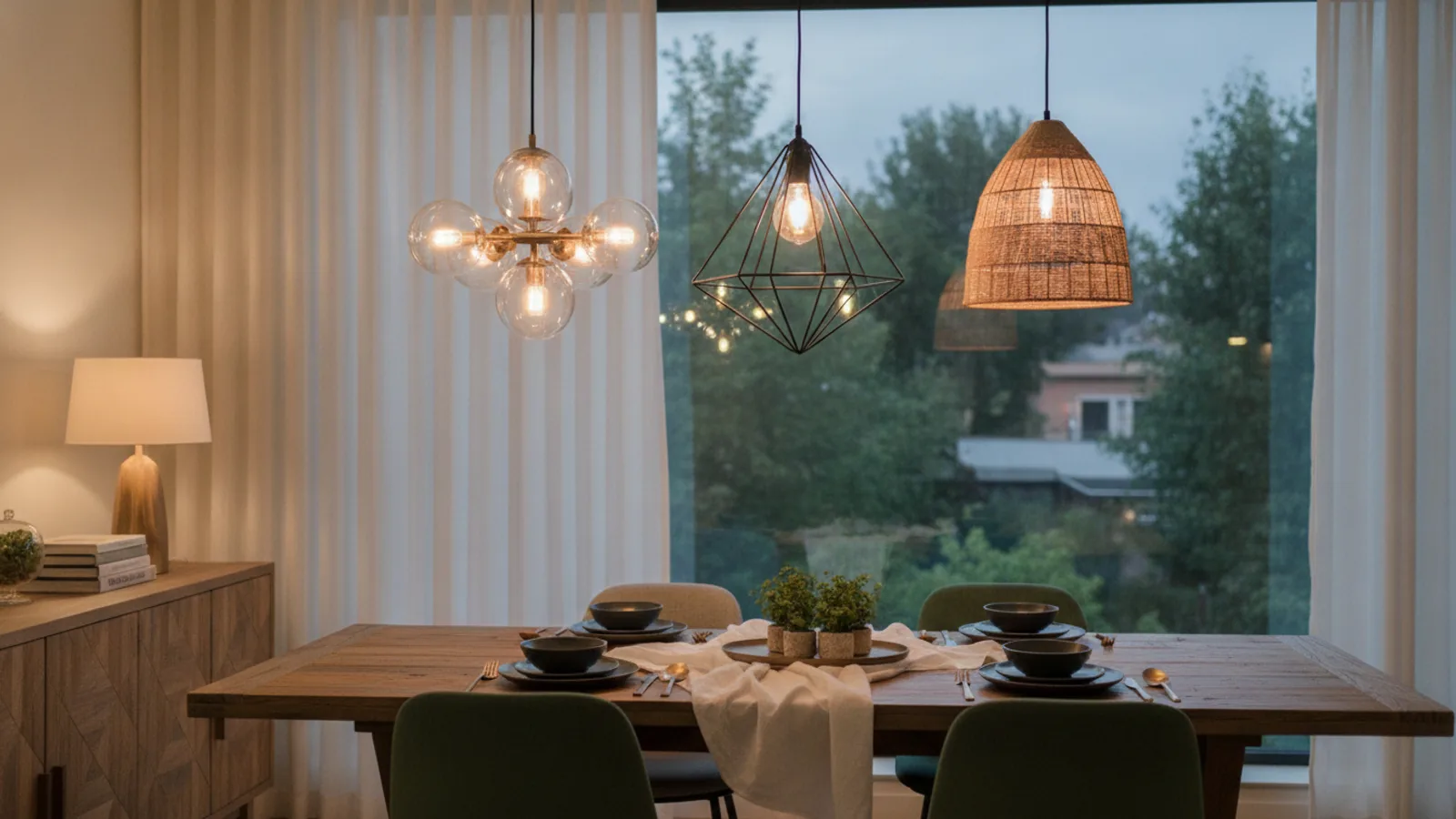
Don't be afraid to let your main dining room light fixture be a work of art. A visually striking chandelier or an oversized pendant can serve as a powerful focal point, defining the room's style even when not illuminated.
When selecting a statement piece, consider its material, form, and how it interacts with the rest of your decor. A bold, geometric fixture might suit a modern space, while an ornate crystal chandelier could complement a traditional setting. Ensure the size is proportionate to your room and dining table to avoid it overwhelming the space or looking too small.
3. Architectural Lighting for Subtle Drama
Architectural lighting integrates seamlessly into the building structure, providing illumination without visible fixtures. This creates a very clean, contemporary look and can add subtle drama.
These types of lights are best planned during renovations or new builds, as they often require custom installation.
4. Leverage Reflective Surfaces
The surfaces in your dining room can greatly enhance or diminish your lighting efforts. Incorporate reflective materials strategically to maximise light distribution and create a sense of spaciousness.
Be mindful not to overdo it, as too many reflective surfaces can create glare.
5. Create Lighting Zones
Instead of just layering light, think about creating distinct lighting zones within your dining room. This is particularly effective in open-plan spaces or larger dining rooms.
For example, you might have one zone for the dining table (ambient + task), another for a reading nook or display cabinet (accent lighting), and a third for a bar cart or serving area (task/accent). Each zone can be controlled independently with its own dimmer switch or smart lighting scene.
This approach allows for incredible versatility, letting you light only the areas you are using and creating different moods in various parts of the room.
Dining Room Lighting Ideas FAQ
Here are answers to some of the most frequently asked questions about lighting your dining room effectively.
How many light sources do I need in a dining room?
As a general rule, aim for at least three layers of light: ambient, task, and accent. This typically translates to a minimum of 3-5 light sources depending on the size of your room. For example, a central overhead fixture (ambient/task), a pair of wall sconces (ambient/accent), and perhaps a small table lamp or some recessed lights (task/accent). More light sources offer greater flexibility in creating different moods and providing adequate illumination for various activities.
What is the ideal height for a pendant light or chandelier above a dining table?
The bottom of your main hanging fixture (chandelier or pendant) should generally be positioned 75-90 cm (30-36 inches) above the surface of your dining table. This height ensures it provides sufficient light over the table without obstructing conversation or views across the table, and without people bumping their heads.
Should I use warm or cool light in my dining room?
For a dining room, warm white light (2700K-3000K) is almost always recommended. This colour temperature creates a cosy, inviting, and intimate atmosphere, making food look more appetising and complexions appear more flattering. Cool white (3500K-4500K) can feel stark and less appealing in a dining setting.
Can I mix different styles of light fixtures in my dining room?
Yes, you absolutely can mix styles, but do so thoughtfully to create a cohesive look rather than a chaotic one. For example, pair a traditional chandelier with modern wall sconces if they share a common element like material, finish, or colour. The key is to ensure there's a unifying theme or a deliberate contrast that makes sense with your overall decor. Avoid mixing too many vastly different styles in a single room.
Do I need an electrician to install new dining room lights?
For simple like-for-like replacements of existing ceiling fixtures, if you are confident and switch off the power, you may be able to do it yourself. However, if you are adding new electrical points, moving existing wiring, installing a dimmer switch for the first time, or dealing with heavy fixtures that require structural reinforcement, it is highly recommended to hire a qualified electrician. This ensures the work is done safely, correctly, and complies with all GB electrical regulations.
How do I choose the right size chandelier for my dining room?
A good rule of thumb is that the width or diameter of your chandelier should be approximately half to two-thirds the width of your dining table. For the room itself, you can add the room's length and width in feet, and that sum in inches can give you a rough guide for the chandelier's diameter. For example, a 10ft x 14ft room would suggest a 24-inch (10+14) chandelier diameter. Always consider both the table and the room dimensions for balance.
Final Checklist for Dining Room Lighting Ideas
Use this checklist to ensure you've covered all the essential aspects of planning and implementing your dining room lighting scheme.
By systematically working through these points, you can achieve a beautifully lit dining room that is both functional and inviting for any occasion.